| |
June
2014
- Volume 8, Issue 3
Professional
commitment among nurses as a moderator of job stress and job
performance : An empirical examination in the Middle East

|
 ( (
|
Muhammad
Jamal
Correspondence:
Muhammad Jamal, Ph.D.
Department of Management
John Molson School of Business
Concordia University
Montreal, Quebec, Canada H3G 1M8
Email: jamal@jmsb.concordia.ca
|
|
|
Abstract
This study examined the relationship of overall job
stress, challenge stress and hindrance stress with job
performance, absenteeism and turnover intention among
hospital nurses (N=255) in the Gulf States of the Middle
East. Multiple sources of data collection were employed.
A structured questionnaire was used to collect data
on measures of job stress and turnover intention. Job
performance and absenteeism data were obtained from
hospital records. Multiple regressions and moderated
multiple regressions were used to analyze data. Overall
job stress, hindrance stress and challenge stress were
significantly related to job performance, absenteeism
and turnover intention. No differential effects of challenge
and hindrance stress were found for the study's three
dependent variables. Professional commitment among nurses
moderated more than 50 percent relationship between
the measures of stress and dependent variables. Overall,
the results of the present study supported the convergence
instead of divergence perspective in international management.
Implications of the findings are discussed for future
researchers in international and cross-cultural management.
|
Introduction
The nursing profession has long been considered a stressful
one globally (Jamal & Baba, 2000). It is one in which
rates of absenteeism, staff turnover and burnout are consistently
high (Hassan, Hassan & King, 2012; Yoon & Kim, 2013).
Two factors are peculiar to the hospital work environment:
the prevalence of shiftwork and the situation of facing patients
in distress, as well as death and dying, on a regular basis
( Al-Hammad et al. 2 012; Jamal & Baba, 1992). These two
factors have been suggested as possible contributors to high
stress and strain among nurses. The present study examined
employees' job stress and job performance relationship among
hospital nurses in the Gulf States, Middle East. Two comprehensive
meta-analyses of stress and performance have highlighted the
importance of this type of empirical study in non-western
countries (Gilboa, Shirom, Fried & Cooper, 2008; Muse,
Harris & Field, 2003). In a recent thought-provoking article,
Zahra (2011) has also alluded to the importance of conducting
rigorous empirical research similar to the Western tradition
in the (new) Middle East. In addition, the present study also
examined the role of professional (occupational) commitment
in the relationship of job stress and job performance (Lee,
Carswell & Allen, 2000).
Job stress refers to an individual's reactions to characteristics
of the work environment that tend to be emotionally and physically
threatening (Jamal, 2007). It points to a poor fit between
the individual's capabilities and the work environment, in
which excessive demands are made of the individual or the
individual is not fully prepared to handle a particular situation
(Jamal, 1984). In general, the higher the imbalance between
the demands and the individual's abilities, the higher will
be the perceived stress (Jamal, 1993). Job performance can
be viewed as an activity in which an individual is able to
accomplish successfully the task assigned to them, subject
to the reasonable utilization of available resources (Jamal,
2007).
Conventionally and historically, job stress has been primarily
viewed as a unidimensional construct affecting individuals'
work attitudes and behavior (Jamal, 2013). In recent years,
it has been suggested that some inconsistent findings between
measures of job stress and employees' attitudes and behavior
might be due to the convention of treating job stress as unidimensional.
These scholars have suggested two distinct dimensions of job
stress: challenge stress and hindrance stress (Cavanaugh,
Bosewell, Roehling & Boudreau, 2000). Challenge stressors
are perceived to be stimuli such as high workload, time pressure
and high level of responsibility. They were labeled as such
because they include potentially stressful demands perceived
effectively under the control of the individual and, if overcome,
they might allow for opportunity for personal growth (Wallace,
Edwards, Arnold, Frazier & Finch, 2009). Hindrance stressors
are stimuli such as organizational policies, red tape, work
role ambiguity and resource inadequacy. They were labeled
as such because they create potentially stressful demands
generally perceived as beyond the control of the employees,
so that they might restrict opportunity for personal growth
(Wallace et al., 2009).
To date, there are only a few empirical studies reported in
the literature employing the two-dimensional conceptualization
of job stress (Clark, 2012; Jamal, 2012; Rodell & Judge,
2009; Wallace et al., 2009). The present study examined the
relationship between challenge stress and hindrance stress
with job performance, absenteeism and turnover intentions
among nurses working in hospitals in the Gulf States, Middle
East. Constructs like job stress, burnout, job satisfaction
and professional commitment are developed and empirically
tested primarily in developed industrialized countries (Baba,
Jamal & Tourigny, 1998; Maslach, 2003). Their portability
and usefulness in developing and non-Western countries have
rarely been examined despite repeated suggestions to do so
(Jamal, 2010; Pudelka, Carr, Fink & Wentage, 2006; Zahra,
2011). In this respect, the present study contributes to international
stress management literature by examining the newly proposed
two dimensions of stress (challenge and hindrance) along with
an independent overall job stress scale (Parker & DeCotiis,
1983) with job performance, absenteeism and turnover intention.
A conceptual framework was developed which guided the present
study. The conceptual framework is presented in Figure 1.
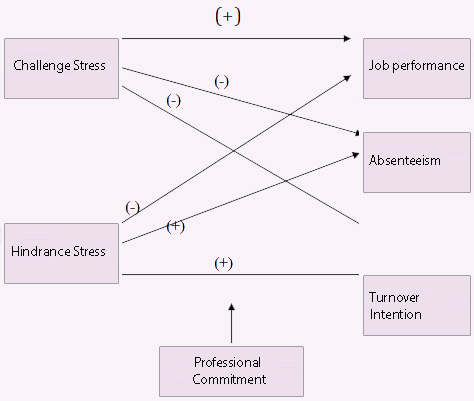
Figure 1: Conceptual framework of stress and outcome relationship
As shown in Figure 1, it is suggested that nurses' professional
commitment may moderate the relationship between measures
of job stress and outcome variables. In the literature, professional
commitment and occupational commitment have been used interchangeably
(Blau, 1985; Lee, Carswell & Allen, 2000). We prefer to
use the term of professional commitment in the present study
as nursing has long been recognized as a "profession"
with a long period of training, exhaustive guidelines and
intense ethical standards (Gould & Fontenla, 2006; Fornes,
Rocco & Wollard, 2008; Yoon & Kim, 2013). When an
individual shows commitment to his profession, the phenomenon
of self-selection plays an important role (Jamal, 1984). In
many cases, individuals who consciously look for certain types
of jobs and professions tend to exhibit stronger commitment
when they are in such jobs. Therefore, it may be the case
that such individuals, through anticipatory socialization,
become more knowledgeable about these jobs, in terms of demands
and excesses, and may appear to be more receptive to job stresses
and general work environment. Whenever these individuals face
adverse things at the job, it does not necessarily lead to
reality shock for them because of their prior learning about
the daily intricacies of their chosen profession / job (Jamal
& Baba, 1992). It is thus predicted that the job performance
of individuals with high professional commitment will be less
affected by high job stress than the performance of individuals
with low professional commitment.
In light of the proposed conceptual model as well as the previous
empirical evidence on job stress, challenge-hindrance stress,
and outcome variables, a number of hypotheses were developed
and tested in the present study. Both overall job stress and
challenge-hindrance stress were employed as independent variables.
Job performance, absenteeism and turnover intention were employed
as dependent variables. Professional commitment was used as
a moderator variable. These hypotheses are listed below:
Hypothesis 1: Overall job
stress will be negatively related to job performance and will
be positively related to absenteeism and turnover intention.
Hypothesis 2: Challenge stress will be positively related
to job performance and will be negatively related to absenteeism
and turnover intention.
Hypothesis 3: Hindrance stress will be negatively related
to job performance and will be positively related to absenteeism
and turnover intention.
Hypothesis 4: Professional commitment will moderate
the relationship between the measures of job stress and three
dependent variables. It is hypothesized that nurses with higher
professional commitment will be better off than nurses with
lower professional commitment.
Method
Research Setting
The present study was conducted among hospital employees in
the Gulf States, Middle East. A number of hospitals were contacted
and invited to participate in the study, explaining the scope
and purpose of the study. All hospitals were publicly funded
and had state-of-the-art medical facilities. Data were collected
primarily from three hospitals which showed the willingness
to support the study.
Procedures
For this study, data were collected by means of a structured
questionnaire. All nursing staff in three hospitals were the
potential respondents. With the help of the hospital administration,
copies of the questionnaire were given to randomly selected
potential respondents along with their paychecks. They were
given instructions to return the completed questionnaire directly
to the researcher at the university address. Approximately
450 questionnaires were given out and with one follow-up reminder,
257 completed questionnaires were returned, yielding a response
rate of 59 percent. It should be acknowledged that this type
of research is rather rare in the Gulf States, and that might
be partially responsible for the modest response rate.
Sample Characteristics
The majority of the respondents were female (88%) and were
married (78%). The average respondent was 34 years of age,
had 14 years of education, 9 years of seniority in the hospital
and had 6 dependents to support. Respondents were quite similar
to non-respondents with regard to a number of background and
socio-demographic variables.
Measures
In line with the recommendation of international management
researchers, standardized scales with known reliabilities
and validities were used to assess the study's independent,
dependent, and moderator variables (Schaffer & Riordan,
2003; Zahra, 2011). It is a requisite for the meaningful comparison
of results with studies done in western industrialized countries.
Overall Job Stress: Overall job stress was assessed
with the 13-item Likert-type scale developed by Parker &
DeCotiis (1983). The scale had one to five response options,
on indicating a strong agreement with the item and five indicating
a strong disagreement. This scale is regularly used to assess
overall job stress and has good psychometric properties (Baba,
Jamal & Tourigny, 1998).
Challenge Stress: Challenge stress was assessed by
the 6-item scale developed by Cavanaugh, Bosewell, Roehling
and Boudreau (2000). This is a Likert-type scale with one
to five response options, one indicating a strong agreement
and five indicating a strong disagreement with the item. Only
limited empirical studies have been conducted using this scale.
However, available empirical evidence indicated good internal
consistency reliability (Jamal, 2012).
Hindrance Stress: Hindrance stress was assessed by
the 5-item scale developed by Cavanaugh, Bosewell, Roehling
and Boudreau (2000). This is also a Likert-type scale with
one to five response options. Because of its short history,
only limited psychometric data are available about this scale,
which has indicated its reasonable internal consistency and
stability (Jamal, 2012).
Job Performance: Job performance data were obtained
from hospital records. All hospitals used a 10-item graphic
rating scale for annual performance appraisal completed by
immediate supervisors. Each item has one to five response
options, five indicating an excellent performance and one
indicating a poor performance. In all three hospitals, the
same performance scale and ratings were used. In the present
study, ratings on ten items were combined to create the index
of overall job performance.
Absenteeism: Absenteeism was assessed by the actual
incidents of absence reported in hospital files for each employee,
for 4 months from the day the questionnaires were distributed.
Frequency of absenteeism was measured instead of the duration
of absence.
Anticipated Turnover: Anticipated turnover was assessed
by asking each respondent to state the probability of his/her
staying with the same hospital for two years, from the day
the questionnaire was completed. This measure has been reported
to be highly correlated with actual turnover (Jamal &
Baba, 2000).
Professional Commitment: Professional commitment was
assessed with the 18-item occupational commitment scale for
nurses developed by Meyer, Allen and Smith (1993). Similar
to the organizational commitment scale, occupational commitment
scale tends to assess affective, continuance, and normative
commitment to the occupation. The scale has one to five response
options, five indicating a strong professional commitment
and one indicating a low professional commitment. This scale
is regularly used in social sciences and has good psychometric
properties (Lee, Carswell & Allen, 2000).
Results
The means (M values), standard deviations (SD values) and
reliability coefficients of all variables with multiple items
are presented in Table 1. Reliabilities (Cronbach's alpha)
varied from .81 (hindrance stress) to .91 (professional commitment).
Overall, reliabilities were considered to be good for survey-type
research design.
Table 1: Means, Standard deviations and reliability coefficients
of study variables
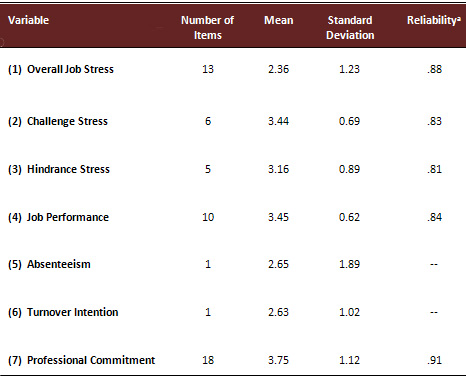
N = 255
a. Reliability coefficients are Cronbach's alpha.
Table 2: Intercorrelations among study's variables
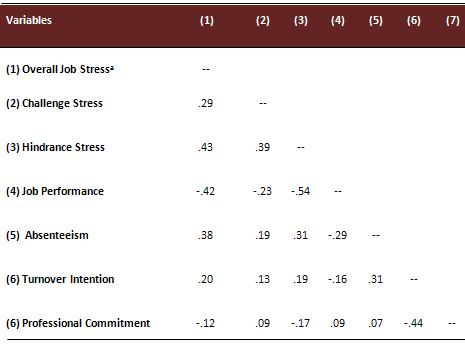
a. N = 255, r = .15, p < .05
Inter-correlations among the study's
variables were computed and are presented in Table 2.
The average correlation among three scales of job stress was
.37. The average correlation among three dependent variables
(performance, absenteeism, turnover intention) was .25. Professional
commitment was weakly correlated with three job stress scales
as well as with two dependent variables. However, professional
commitment showed a moderate negative correlation with turnover
intention which indicated their shared nomological network.
To test hypotheses 1 to 3, bivariate multiple regressions
were computed after controlling for age, gender, marital status,
and seniority. Results are presented in Table 3.
Table 3: Multiple regression of
overall job stress, challenge stress and hindrance stress
with three dependent variables
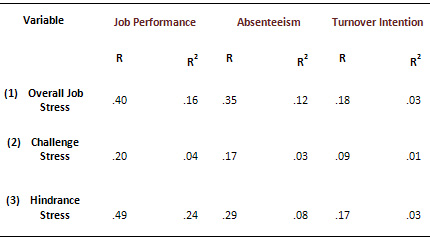
N = 255, R = .14, p < .05
Overall job stress was significantly
related to job performance, absenteeism and turnover intention
in the predicted direction, thus supporting hypothesis 1.
Challenge stress was significantly related to job performance
and absenteeism, but was not related to turnover motivation.
However, in both significant relationships, the direction
of the relationship was contrary to the hypothesized relationship.
Thus, hypothesis 2 was not supported by data in the present
study. Hindrance stress was significantly related in the predicted
direction to job performance, absenteeism and turnover motivation,
thus supporting hypothesis 3. In sum, overall job stress,
hindrance stress and challenge stress were found to be related
to job performance, absenteeism and turnover motivation in
the same manner. No differential effects of challenge and
hindrance stress on three dependent variables were found in
this study. However, it is noted that the strength of correlation
was stronger for hindrance stress than for challenge stress
(-.54 vs -.23 for job performance; .31 vs .19 for absenteeism).
Moderated multiple regressions were used to test hypothesis
4 which concerned the interactive effects of professional
commitment on three dependent variables. Hierarchical regression
analysis was performed in which overall job stress was entered
first, followed by professional commitment, and then overall
job stress and professional commitment. A summary of results
are presented in Table 4. Professional commitment appeared
to be an important moderator in this sample of nurses, moderating
five of the nine relationships between three measures of job
stress and three dependent variables. Job performance and
absenteeism were the dependent variables in which the moderating
effect of professional commitment was more prominent.
Table 4: Results from hierarchical moderated multiple regression
analysis showing the relationship between overall job stress,
challenge stress, hindrance stress, and professional commitment
with three dependent variables.
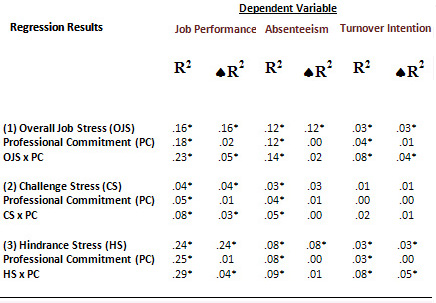
* p < .05
The unique variance explained by the interaction effects
of overall job stress and professional commitment was 5 percent
for job performance and 4 percent for turnover intention.
The unique variance explained by the interaction effects of
challenge stress and professional commitment was 3 percent
for job performance. The unique variance explained by the
interaction effects of hindrance stress and professional commitment
was 4 percent for job performance and 5 percent for turnover
intention. A close examination of the data through subgroup
analysis indicated that nurses with high professional commitment
appeared to be better off than nurses with low professional
commitment in terms of the negative consequences of job stress.
No significant interaction effects were found with the dependent
variable, absenteeism. Thus, hypothesis 4 was only partially
supported by the data in this study.
Discussion
The results of the present study derived from hospital nurses
in the Gulf States, Middle East supported the relationship
between the measures of job stress and outcome variables of
job performance, absenteeism and turnover intention. Overall
job stress was negatively related to job performance and was
positively related to nurses' absenteeism and turnover intention.
Contrary to our prediction, challenge stress was also negatively
related to job performance and positively related to absenteeism.
Hindrance stress was negatively related to job performance
and was positively related to nurses' absenteeism and turnover
intention. Before the findings are discussed any further,
a note of caution is warranted about the limitations of the
study which might include perceptual measures of three job
stress scales, turnover intention, nurses' professional commitment,
a modest response rate, and cross-sectional research design.
For future research, it will be desirable to use objective
measures of job stress along with perceptual measures and
to use longitudinal research design for greater confidence
in results.
The absence of differential effects of challenge stress and
hindrance stress on nurses' job performance, absenteeism is
not only contrary to the two-dimensional framework of job
stress (Cavanaugh et al., 2000) but also to a few empirical
studies on the topic. For example, in a recent study of 215
employees across 61 offices of a state agency in the U.S.,
the authors noted a modest positive relationship between challenge
stress and role-based performance and a negative relationship
between hindrance stress and role-based performance (Wallace
et al., 2009). However, the average correlation between challenge
stress and four measures of performance was a meager +.12,
while the average correlation between hindrance stress and
the four measures of performance was -.35. In a recent study
of employees in a multinational organization in Malaysia (N
= 305) and Pakistan (N = 325), job stressors similar to challenge
stress (i.e. work overload) and stressors similar to hindrance
stress (i.e. work conflict, ambiguity, resource inadequacy)
were found to be negatively related to job performance (Jamal,
2011). The results of the present study along with two recent
studies on the topic (Jamal, 2011; Wallace et al., 2009) lend
support to the pervasive effects of stress on employee and
organization well-being and in general tend to be consistent
with the bulk of existing literature on job stress (Eatongh,
Change, Miloslavic & Johnson, 2011; Jamal, 2010). Empirical
evidence, perhaps, suggests clearly that chronic job stress,
lasting a relatively long time or even permanently, affects
employees' and organizations' health and well-being inversely.
Any notion of calling some stress as challenge and good for
the individual is not well supported by the empirical studies
on job stress outcome relationships. Since the data for the
present study was collected in the Gulf States of the Middle
East with a strong collectivistic cultural orientation (Hofstede,
2001), the results of the present study tend to be more supportive
of the convergence as opposed to divergence perspective in
international and cross-cultural management (Pudelko et al.,
2006)
Professional commitment among nurses moderated five of the
nine relationships between three measures of job stress and
three dependent variables - performance, absenteeism and turnover
intention. According to the test suggested by Brozek &
Tiede (1952), the probability of this number of differences
occurring by chance is less than .01. Though professional
commitment moderated more than 50 percent of the relationship
between job stress and outcome variables, yet the dominant
patterns of results in both significant and non-significant
comparison was that nurses who showed higher professional
commitment appeared to be better off against the negative
consequences of job stress than nurses who showed low professional
commitment. Thus, in the present study, professional commitment
acts as a buffer against the aversive effects of job stress
on nurses' job performance and work behavior. Since nurses
are the essential part of the healthcare system globally,
it is highly recommended that management should pay serious
attention to factors which might enhance professional commitment
and reduce or even remove factors which hinder professional
commitment. A recent British study has provided insights into
factors which might lead to increased professional commitment
and they included team work, feedback from patients, the variety
of work, good support from management, family friendly work
environment, support from doctors, and the multidisciplinary
team work (Gould & Fontenla, 2006). Similarly, nursing
literature has also provided insights into factors which might
lead to decrease in professional commitment among hospital
nurses and they included factors such as shift work (especially
quick rotating shifts), verbal and physical abuse, poor pay,
heavy work load, work-life imbalance, too much paper work
and poor image of nursing held by the public (AbuAlRub, 2004;
Gould & Fontenla, 2006; Harrison, Newman & Roth, 2006;
Lu, Change & Wu, 2007).
In sum, the present study found the negative relationship
between the measures of job stress and job performance and
the positive relationship between the measures of job stress
and absenteeism and turnover intention among hospital nurses.
Professional commitment was found to be an important moderator
of job stress and outcome relationship. Measures of job stress
assessed in the present study were of the nature which will
be affected primarily through management actions. Therefore,
it is recommended that management invest time and resources
toward discovering how job stress among nurses might be managed
for better performance, well-being and retention of hospital
nurses (Jamal, 2007; Schmidt, 2007). In addition, it is felt
that despite management's concerted efforts and serious actions
to combat job stress, it is probably going to remain an important
concern for many in the world of work for years to come, primarily
because of our incomplete knowledge of what causes stress
in many job situations. Among hospital nurses, building and
enhancing professional commitment may be an important mechanism
in combating some of the aversive effects of job stress (Fornes,
Rocco & Wollard, 2004). As the process of globalization
becomes more pervasive in coming years, it seems more important
that these strategies should reflect a cross cultural perspective
(Al-Roubaie, 2002; Alvi & Al-Roubaie. 2011).
References
Alasmari, H.A. & Douglas, C. (2012). Job satisfaction
and intent to leave among critical care nurses in Saudi Arabia.
Middle East Journal of Nursing, 6 (4), 3-12.
Al-Hammad, F. A., Raheel, H., Al-Baiz, L. E. & Al-Otaibi,
A. M. (2012). The effect of shift work on psychological stress,
sleep pattern and health of nurses working at a tertiary hospital,
Riyadh. Middle East Journal of Nursing, 6 (6), 14-20.
Alvi, S. A. & Al-Roubaie, A. (2011). Globalization of
Knowledge: Islam and its Contribution. Bloomington, Indiana,
USA: Trafford Publishing.
AbuAlRub, R.F. (2004). Job stress, job performance and social
support among hospital nurses. Journal of Nursing Scholarship,
36, 73-79.
Al-Roubaie, A. (2002). Globalization and the Muslim World.
Kuala Lumpur, Malaysia: Malita Jaya Publishing House.
Baba, V.V., Jamal, M. & Tourigny, L. (1998). Work and
mental health: A decade in Canadian research. Canadian Psychology,
38, 94-107.
Blau, G. (1988). Further exploring the meaning and measurement
of career commitment. Journal of Vocational Behavior, 32,
284-297.
Brozek, J. & Tiede, K. (1952). Reliable and questionable
significance in a series of statistical tests. Psychological
Bulletin, 49, 339-341.
Cavanaugh, M.A., Boswell, W.R., Roehling, M.V. & Boudreau,
J.W. (2000). An empirical examination of self-reported work
stress among U.S. managers. Journal of Applied Psychology,
85, 65-74.
Clark, S. (2012). The effects of challenge and hindrance stressors
on safety behavior and safety outcomes: A meta-analysis. Journal
of Occupational Health Psychology, 17, 387-397
Eatongh, E.M., Change, C. Miloslavic, S.A. & Johnson,
R.E. (2011). Relationship of role stressors with organizational
citizenship behavior: A meta-analysis. Journal of Applied
Psychology, 96, 619-632.
Fornes, S.L., Rocco, T.S. & Wollard, K.K. (2004). Workplace
commitment: A conceptual model developed from integrative
review of the research. Human Resource Development Review,
7, 339-357.
Gilboa, S., Shirom, A., Fried, Y. & Cooper, C. (2008).
A meta-analysis of work demand stressor and job performance:
Examining main and moderating effects. Personnel Psychology,
61, 227-271.
Gould, D. & Fontenla, M. (2006). Commitment to nursing:
results of a qualitative interview study. Journal of Nursing
Management, 14, 213-221.
Hassan, J., Hassan, A. & King, M. L. (2012). Nursing image
in Qatar: Past, present and future.
Middle East Journal of Nursing, 6 (4), 26-28.
Harrison, D.A., Newman, D.A. & Roth, P.L. (2006). How
important are job attitudes? A meta-analytic comparison of
integrative behavioral outcomes and time sequences. Academy
of Management Journal, 49, 305-325.
Hofstede, G. (2001). Culture's Consequences. 2nd Edition.
Thousand Oaks, California: Sage Publications.
Jamal, M. (1984). Job stress and job performance controversy:
An empirical assessment. Organizational Behavior and Human
Performance, 33, 1-21.
Jamal, M. (2007). Job stress and job performance controversy
revisited: An empirical examination in two countries. International
Journal of Stress Management, 14, 175-187.
Jamal, M. (2010). Burnout among Canadian, Chinese, Malaysian
and Pakistani employees: An empirical examination. International
Management Review, 6, 31-41.
Jamal, M. (2011). Job stress, job performance and organizational
commitment in a multinational company. International Journal
of Business and Social Science, 2, 20-29.
Jamal, M. (2013). Job stress among hospital employees in the
Middle East: Social support and
Type A behavior as moderators. Middle East Journal of Business,
8 (3), 7-16.
Jamal, M. & Ahmed, S.W. (2012). Challenge-hindrance stress,
burnout, job satisfaction and health: Type A behavior as a
moderator. International Journal of Business and Management
Tomorrow, 2 (May), 1-8.
Jamal, M. & Baba, V.V. (2000). Job stress and burnout
among Canadian managers and nurses. Canadian Journal of Public
Health, 91, 454-458.
Jamal, M. & Baba, V.V. (1992). Shift work and department
type related to job stress, and work attitudes and behavioral
intentions: A study of nurses. Journal of Organizational Behavior,
13, 449-464.
Jamal, M. & Badawi, J.A. (1993). Job stress among Muslim
immigrants in North America: Moderating effects of religiosity.
Stress Medicine, 9, 145-151.
Lee, K., Carswell, J.J. & Allen, N.J. (2000). A meta-analytic
review of occupational commitment: Relations with persons
and work related variables. Journal of Applied Psychology,
85, 799-811.
Lu, K.Y., Change, L.C. & Wu, H.L. (2007). Relationships
between professional commitment, job satisfaction, and work
stress in public health nurses in Taiwan. Journal of Professional
Nursing, 23, 110-116.
Maslach, C. (2003). Job burnout: New directions in research
and intervention. Current Directions in Psychological Science,
2, 189-192.
Meyer, J.P., Allen, N.J. & Smith, C.A, (1993). Commitment
to organization and occupations: Extension and test of a three-component
conceptualization. Journal of Applied Psychology, 78, 538-551.
Muse, L.A., Harris, S.G. & Field, H.S. (2003). Has the
inverted-U theory of stress and job performance had a fair
test? Human Performance, 16, 349-364.
Parker, D.F. & DeCotiis, T.A. (1983). Organizational determinants
of job stress. Organizational Behavior and Human Performance,
32, 160-167.
Pudelko, M., Carr, C. Fink, G. & Wentahe, P. (2006). The
convergence concept in cross cultural management research.
International Journal of Cross Cultural Management, 6, 15-18.
Rodell, J.B. & Judge, T.A. (2009). Can "good"
stressors spark "bad" behaviors? The mediating role
of emotions in links of challenge and hindrance stress with
citizenship and counter productive behaviors. Journal of Applied
Psychology, 94, 1438-1451.
Schaffer, B.S. & Riordan, C.M. (2003). A review of cross-cultural
methodologies for organizational research. Organizational
Research Methods, 6, 169-215.
Schmidt, K.H. (2007). Organizational commitment: A further
moderator in the relationship between work stress and strain.
International Journal of Stress Management, 14, 26-40.
Wallace, J.C., Edwards, B.D., Arnold, J., Frazier, M.L. &
Finch, D.M. (2009). Work stressors, role based performance
and the moderating influence of organizational support. Journal
of Applied Psychology, 94, 254-262.
Yoon, S. L. & Kim, J. H. (2013). Job related stress, emotional
labor, and depressive symptoms among Korean nurses. Journal
of Nursing Scholarship, 45, 1-8.
Zahra, S. A. (2011). Doing research in the (New) Middle East:
Sailing with the wind. Academy of Management Perspective,
10 (November) 1-16.
Acknowledgements
This study was supported by grants from the Social Sciences
Research Council of Canada (410-99-0203; S00 802, 2003-2006)
and Fonds pour la formation de chercheurs de l'aide à
la recherche from the Province of Quebec (99-ER-0506). The
author acknowledges the cooperation and help of Dr. Amer Al-Roubaie,
Dr. Haroon Yusuf, Dr. Muhammad Ismail, Ms. Shima Husen, and
many research assistants in Montreal and overseas in data
collection and analysis. Requests for reprints should be made
to Dr Muhammad Jamal, Department of Management, John Molson
School of Business, Concordia University, Montreal, Quebec,
Canada, H3G 1M8 (E-mail: mjamal@jmsb.concordia.ca)
|
 |